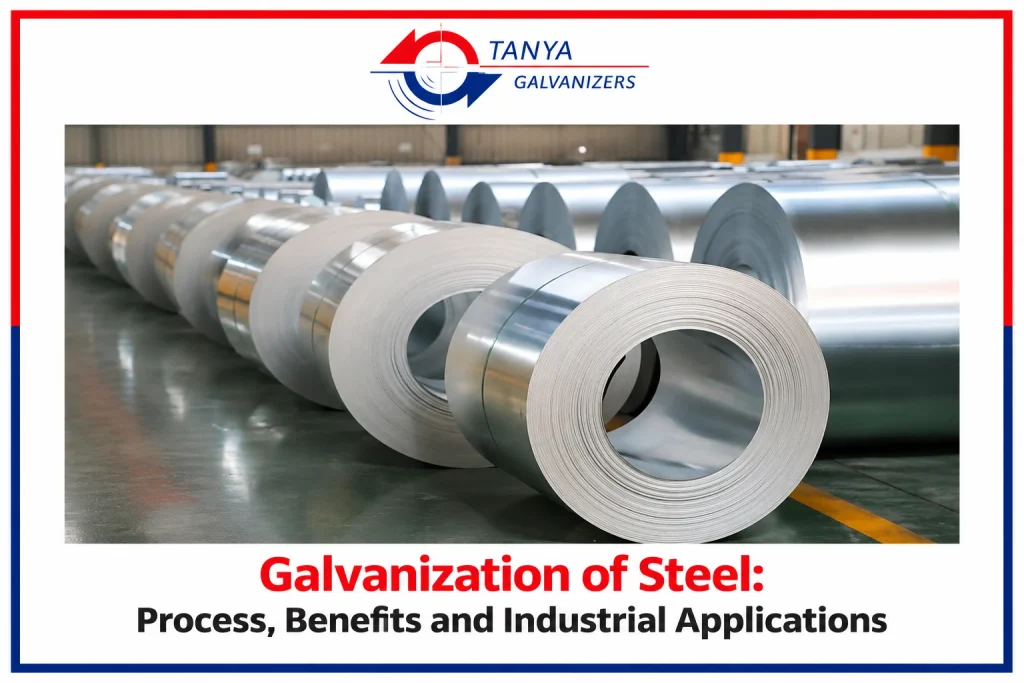
Steel holds up our bridges and transmission towers, yet bare steel can start rusting within weeks in humid air. The galvanization of steel solves this by bonding a layer of zinc to the surface, so the metal underneath stays protected for decades. At Tanya Galvanizers, we coat structures for power plants, railways, refineries, and cement units from our plant at Manjusar GIDC, Vadodara. Project after project, we see how much a good zinc coating changes the life of a structure.
What is the galvanization of steel?
Galvanization is the process of coating steel with zinc to prevent corrosion. The zinc does two jobs. It forms a barrier that keeps moisture and oxygen away from the steel. If the surface gets scratched, the zinc corrodes first and shields the exposed steel. This second effect is called sacrificial or cathodic protection, and paint cannot offer it.
How does the hot dip galvanizing process work?
Hot dip galvanization is the most widely used method for structural steel in India. In our experience, the final coating is only as good as the surface preparation behind it. The process has five stages:
- Degreasing: a hot alkaline solution removes oil, grease, and dirt.
- Pickling: dilute hydrochloric acid strips away rust and mill scale.
- Fluxing: a zinc ammonium chloride solution stops fresh oxides from forming before dipping.
- Zinc dipping: the steel is immersed in molten zinc at around 450°C, where iron and zinc react to form tough alloy layers.
- Cooling and inspection: the coated steel is cooled and checked for thickness, adhesion, and uniformity.
At our plant, coating thickness is tested as per IS 4759 and IS 6745, and adhesion is checked as per IS 2629.
Did you know? The word galvanize comes from Luigi Galvani, an Italian scientist of the 1700s who studied electricity in living tissue. The zinc dipping process itself was first patented in France in 1837.
What are the types of galvanizing?
Not every galvanized product is made the same way. The method decides how thick the zinc layer is and how long it lasts outdoors.
| Method | Typical coating thickness | Durability | Common uses |
| Hot dip galvanizing | 45 to 85 microns or more | 25 to 50+ years outdoors | Structures, towers, cable trays, crash barriers |
| Electro galvanizing | 5 to 25 microns | Best for indoor or mild exposure | Fasteners, auto parts, appliances |
| Pre galvanized steel | About 20 microns per side | Moderate, cut edges stay bare | Roofing sheets, ducts, light sections |
For outdoor and heavy-duty work, hot-dip galvanizing leads in both coating thickness and coverage. Our earlier guide explains the difference between electro-galvanised and hot-dip galvanized steel in more detail.
What are the benefits of galvanized steel?
The biggest benefit is service life. Galvanized steel can last over 50 years in rural areas and around 20 to 25 years in coastal or industrial zones. Our guide on how long galvanized steel lasts in Indian weather explains these ranges in detail.
Cost is the second advantage. Painted steel needs fresh coats every few years, which means scaffolding, labour and downtime. A galvanized coating is applied once and usually needs little attention after that.
Coverage matters too. Because the whole part goes into the zinc bath, the inside of hollow sections, corners and edges all get coated. The alloy layers are also harder than the base steel, so the coating resists knocks during transport and erection. Both zinc and steel are fully recyclable as well.
Where is galvanized steel used in industry?
Galvanized steel turns up wherever steel faces weather, chemicals, or soil. Common applications include:
- Power transmission towers and substation structures
- Solar module mounting structures
- Cable trays, raceways and earthing strips
- Highway crash barriers and bridge railings
- Fertilizer, cement and petrochemical plant structures
- Agricultural fencing and greenhouse frames
Indian infrastructure projects increasingly specify galvanized components, because a corroded part on a live line or highway is costly to replace.
Why does the choice of galvanizer matter?
Two plants can dip the same steel and get absolutely different results. It’s the bath chemistry, the pickling control, the venting and drainage design, and the sheer quality of the inspection that will determine whether a coating will last 15 years or 50. Reliable galvanisation of steel is down to discipline at every stage, not just the dip. Find out what standards your galvaniser tests to and how they record coating thickness.
Partner with Tanya Galvanizers for coatings that last
Tanya Galvanisers have many years of experience on power plants, cooling tower manufacturers, rail and refinery projects. Each batch is carefully prepared, dipped in zinc, and tested to Indian standards. Just send us your drawings or project specs, and we’ll be able to recommend the appropriate coating for your application and your budget.
FAQs
Galvanization of steel is the process of coating steel with a layer of zinc. The zinc blocks moisture and oxygen and corrodes first when scratched, which protects the steel underneath from rust for many years.
Hot-dip galvanised steel in rural areas can last over 50 years without any maintenance at all. In coastal or heavy industry areas, it’s probably 20 to 25 years (again, that will be dependent on the thickness of the coating and the severity of the local environment).
Molten zinc in a hot-dip galvanizing bath is kept at around 450°C. At this temperature, zinc reacts with the iron in steel and forms strong alloy layers that bond the coating firmly to the steel surface.
Hot-dip galvanizing dips steel in molten zinc and gives a thick coating of 45 to 85 microns or more. Electro-galvanizing uses electric current, giving a thin coating of 5 to 25 microns, suited mainly to indoor use.
Yes, galvanized steel can be painted or powder coated. This combination is called a duplex system. The surface must be properly cleaned and prepared first, and together the two coatings can protect steel much longer than either alone.