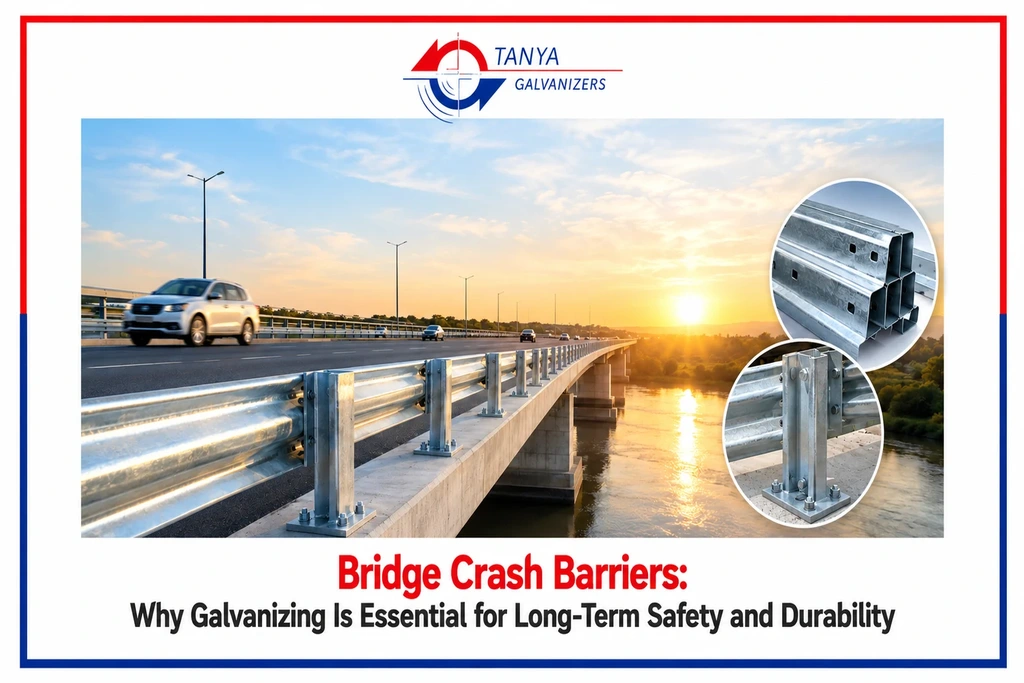
Why galvanizing is essential for Bridge Crash Barrier safety and durability
A Bridge Crash Barrier has one job. It must stop a vehicle from leaving the deck. On a flyover or river crossing, a failed barrier can mean a fall of 10 metres or more, so the steel has to stay strong for decades. Galvanizing is what keeps it that way.
In our experience at Tanya Galvanizers International, rust rarely causes a dramatic failure. It works slowly, thinning bolts and post bases until the barrier can no longer absorb an impact.
Why do crash barriers on bridges corrode faster?
The steel used on bridges is exposed to more severe conditions than most roadside steel. Rainwater gathers at the edge of the bridge deck, the water from the drains splashes against the posts, and wind blows moisture from rivers or the sea. In coastal and industrial areas, chlorides and sulphur accelerate rusting even more.
Repainting a barrier on a busy bridge means lane closures and crews working at height. As a result, most bridge barriers get far less maintenance than the design assumed.
Bare mild steel in a C4 (high corrosivity) environment can lose 50 to 80 microns of thickness in a single year, based on ISO 9223 corrosion categories. A 3 mm W beam cannot afford that for long.
How does galvanizing protect a crash barrier?
Hot-dip galvanizing covers the steel in a metallurgically bonded zinc coating. The zinc acts as a physical shield against moisture. It also corrodes first, sacrificially, so even a scratched or cut edge stays protected. Zinc wears at roughly one tenth to one thirtieth the rate of bare steel.
Highway barriers take regular knocks from vehicles and debris. Paint peels at the point of damage and rust spreads underneath it. A galvanized coating keeps working around the damaged spot.
For crash barrier corrosion protection, full immersion is a big advantage. The molten zinc reaches inside joints and bolt holes, where brushes and spray guns often miss.
What coating standard should a Bridge Crash Barrier meet?
In India, the galvanising of crash barriers is governed by IS 4759. According to the specifications of the Ministry of Road Transport and Highways, a minimum zinc coating of 550 g/m² is required for the W beam and three beam sections, equivalent to about 77 microns. ISO 1461 is also frequently referred to in international projects.
Bolts and nuts should carry a hot-dip coating to IS 1367, so they last as long as the beams. A barrier is only as strong as its weakest bolt.
In our plant, we check coating thickness with a magnetic gauge on every batch and file the readings for client audits.
How long does a hot-dip galvanized crash barrier last?
A crash barrier made of hot-dip galvanised metal, with a zinc coating thickness of about 80 microns, generally lasts between 20 and 40 years under most of the conditions found in India without the need for repainting; those located on the coast tend to be at the lower end of this range, whereas those on dry inland highways usually have a much longer service life.
Painted steel, by comparison, typically needs recoating every 5 to 7 years. Over a 30-year bridge life, that adds up to four or five maintenance cycles, each with its own traffic disruption. Galvanizing costs slightly more at the start. Even so, the lifetime cost usually comes out lower. Our guide on galvanized steel life in Indian weather covers this in more detail.
What should you ask crash barrier manufacturers about galvanizing?
Ask which standard the galvanizing follows and what coating thickness is guaranteed. Request a test certificate for every lot, including thickness and adhesion results. Reliable Crash Barrier Manufacturers share these records readily and keep them on file, because they have nothing to hide.
Also look out for common galvanizing defects such as bare spots, heavy dross lumps, or flaking at the edges. Small bare areas can be repaired with zinc-rich paint as IS 4759 allows. Larger ones mean the part needs stripping and redipping.
Choose a galvanizing partner you can trust
At Tanya Galvanizers International, our plant galvanizes W beams, three beams, posts, and spacers to IS 4759. Every batch goes through our hot-dip galvanization process with documented quality checks. We treat every barrier as safety equipment from the day it leaves our plant.
If you are planning a Bridge Crash Barrier package for a highway or flyover project, talk to our team early. We can advise on coating thickness, fastener protection, and delivery schedules. Explore our crash barrier galvanizing services or contact Tanya Galvanizers International today for a quote.
FAQs
Galvanization involves coating the steel with zinc, which prevents moisture from causing corrosion sooner than the steel itself does. As a result, the beams, posts, and bolts retain their full strength so that the barrier can still withstand a vehicle impact many years after it has been installed.
Most bridge and highway crash barriers in India follow IS 4759, with MoRTH specifications asking for at least 550 g/m² of zinc on W-beam and three-beam sections. ISO 1461 is common on international projects.
In Indian conditions, a hot-dip galvanised crash barrier generally remains usable for between 20 and 40 years without having to be repainted, although those in coastal and industrial areas tend to have a shorter lifespan, while those on dry inland highways tend to last longer.
In severe conditions, paint can remain usable for a period of five to seven years; hot-dip galvanizing attaches zinc to the steel, protects the cut edges, and endures much longer, which is why the total cost of ownership of a galvanized barrier is generally lower.
For each batch, obtain the galvanizing standard, the guaranteed coating thickness, and a test certificate. Reliable manufacturers of crash barriers make their thickness and adhesion results publicly available and keep these records for future audits.