Bridge Crash Barriers: Why Galvanizing Is Essential for Long-Term Safety and Durability 

Bridge Crash Barriers: Why Galvanizing Is Essential for Long-Term Safety and Durability

Why galvanizing is essential for Bridge Crash Barrier safety and durability

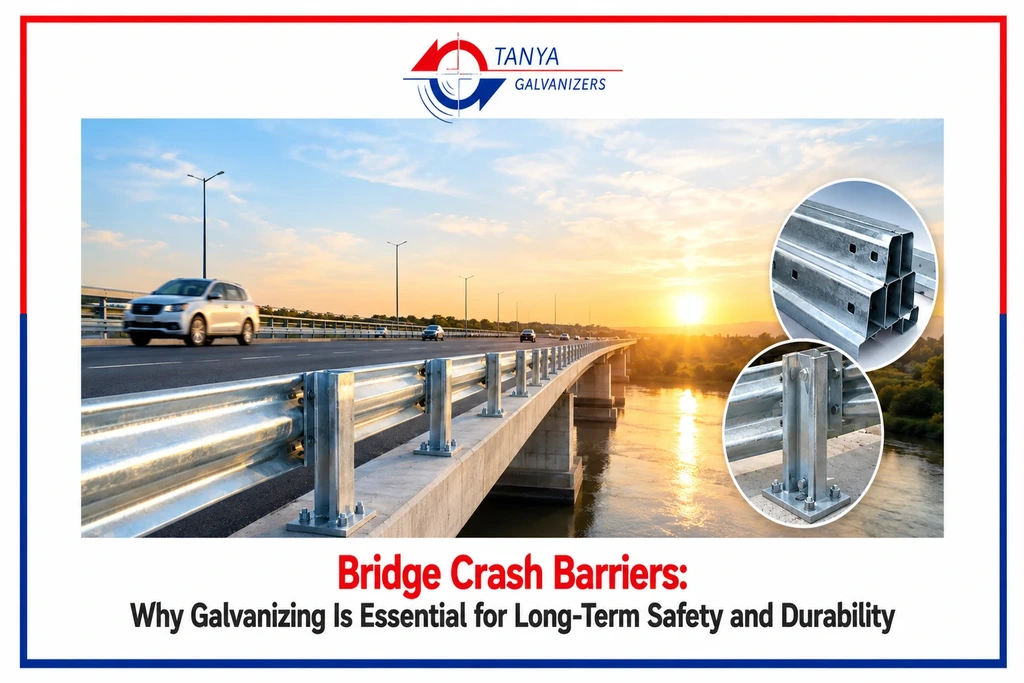
A Bridge Crash Barrier has one job. It must stop a vehicle from leaving the deck. On a flyover or river crossing, a failed barrier can mean a fall of 10 metres or more, so the steel has to stay strong for decades. Galvanizing is what keeps it that way.

In our experience at Tanya Galvanizers International, rust rarely causes a dramatic failure. It works slowly, thinning bolts and post bases until the barrier can no longer absorb an impact.

Why do crash barriers on bridges corrode faster?

The steel used on bridges is exposed to more severe conditions than most roadside steel. Rainwater gathers at the edge of the bridge deck, the water from the drains splashes against the posts, and wind blows moisture from rivers or the sea. In coastal and industrial areas, chlorides and sulphur accelerate rusting even more.

Repainting a barrier on a busy bridge means lane closures and crews working at height. As a result, most bridge barriers get far less maintenance than the design assumed.

Bare mild steel in a C4 (high corrosivity) environment can lose 50 to 80 microns of thickness in a single year, based on ISO 9223 corrosion categories. A 3 mm W beam cannot afford that for long.

How does galvanizing protect a crash barrier?

Hot-dip galvanizing covers the steel in a metallurgically bonded zinc coating. The zinc acts as a physical shield against moisture. It also corrodes first, sacrificially, so even a scratched or cut edge stays protected. Zinc wears at roughly one tenth to one thirtieth the rate of bare steel.

Highway barriers take regular knocks from vehicles and debris. Paint peels at the point of damage and rust spreads underneath it. A galvanized coating keeps working around the damaged spot.

For crash barrier corrosion protection, full immersion is a big advantage. The molten zinc reaches inside joints and bolt holes, where brushes and spray guns often miss.

What coating standard should a Bridge Crash Barrier meet?

In India, the galvanising of crash barriers is governed by IS 4759. According to the specifications of the Ministry of Road Transport and Highways, a minimum zinc coating of 550 g/m² is required for the W beam and three beam sections, equivalent to about 77 microns. ISO 1461 is also frequently referred to in international projects.

Bolts and nuts should carry a hot-dip coating to IS 1367, so they last as long as the beams. A barrier is only as strong as its weakest bolt.

In our plant, we check coating thickness with a magnetic gauge on every batch and file the readings for client audits.

How long does a hot-dip galvanized crash barrier last?

A crash barrier made of hot-dip galvanised metal, with a zinc coating thickness of about 80 microns, generally lasts between 20 and 40 years under most of the conditions found in India without the need for repainting; those located on the coast tend to be at the lower end of this range, whereas those on dry inland highways usually have a much longer service life.

Painted steel, by comparison, typically needs recoating every 5 to 7 years. Over a 30-year bridge life, that adds up to four or five maintenance cycles, each with its own traffic disruption. Galvanizing costs slightly more at the start. Even so, the lifetime cost usually comes out lower. Our guide on galvanized steel life in Indian weather covers this in more detail.

What should you ask crash barrier manufacturers about galvanizing?

Ask which standard the galvanizing follows and what coating thickness is guaranteed. Request a test certificate for every lot, including thickness and adhesion results. Reliable Crash Barrier Manufacturers share these records readily and keep them on file, because they have nothing to hide.

Also look out for common galvanizing defects such as bare spots, heavy dross lumps, or flaking at the edges. Small bare areas can be repaired with zinc-rich paint as IS 4759 allows. Larger ones mean the part needs stripping and redipping.

Choose a galvanizing partner you can trust

At Tanya Galvanizers International, our plant galvanizes W beams, three beams, posts, and spacers to IS 4759. Every batch goes through our hot-dip galvanization process with documented quality checks. We treat every barrier as safety equipment from the day it leaves our plant.

If you are planning a Bridge Crash Barrier package for a highway or flyover project, talk to our team early. We can advise on coating thickness, fastener protection, and delivery schedules. Explore our crash barrier galvanizing services or contact Tanya Galvanizers International today for a quote.

FAQs

1. Why is galvanizing important for crash barriers?

Galvanization involves coating the steel with zinc, which prevents moisture from causing corrosion sooner than the steel itself does. As a result, the beams, posts, and bolts retain their full strength so that the barrier can still withstand a vehicle impact many years after it has been installed.

2. What standard applies to crash barrier galvanizing in India?

Most bridge and highway crash barriers in India follow IS 4759, with MoRTH specifications asking for at least 550 g/m² of zinc on W-beam and three-beam sections. ISO 1461 is common on international projects.

3. How long does a hot-dip galvanized crash barrier last?

In Indian conditions, a hot-dip galvanised crash barrier generally remains usable for between 20 and 40 years without having to be repainted, although those in coastal and industrial areas tend to have a shorter lifespan, while those on dry inland highways tend to last longer.

4. Is galvanizing better than painting for crash barriers?

In severe conditions, paint can remain usable for a period of five to seven years; hot-dip galvanizing attaches zinc to the steel, protects the cut edges, and endures much longer, which is why the total cost of ownership of a galvanized barrier is generally lower.

5. What should I check before buying galvanized crash barriers?

For each batch, obtain the galvanizing standard, the guaranteed coating thickness, and a test certificate. Reliable manufacturers of crash barriers make their thickness and adhesion results publicly available and keep these records for future audits.
How Galvanized Crash Barriers Can Support India’s Bharatmala & Black Spot Rectification Projects

Crash Barrier Manufacturers

India is building roads faster, and with that speed comes responsibility. Every kilometre added under the Bharatmala Pariyojana and every accident-prone stretch identified under the Black Spot Rectification program comes with one silent expectation: that the safety infrastructure lining these roads will actually hold up. This is exactly where crash barrier manufacturers step into the picture, not as an afterthought but as a core part of how India’s highways are designed to protect lives.

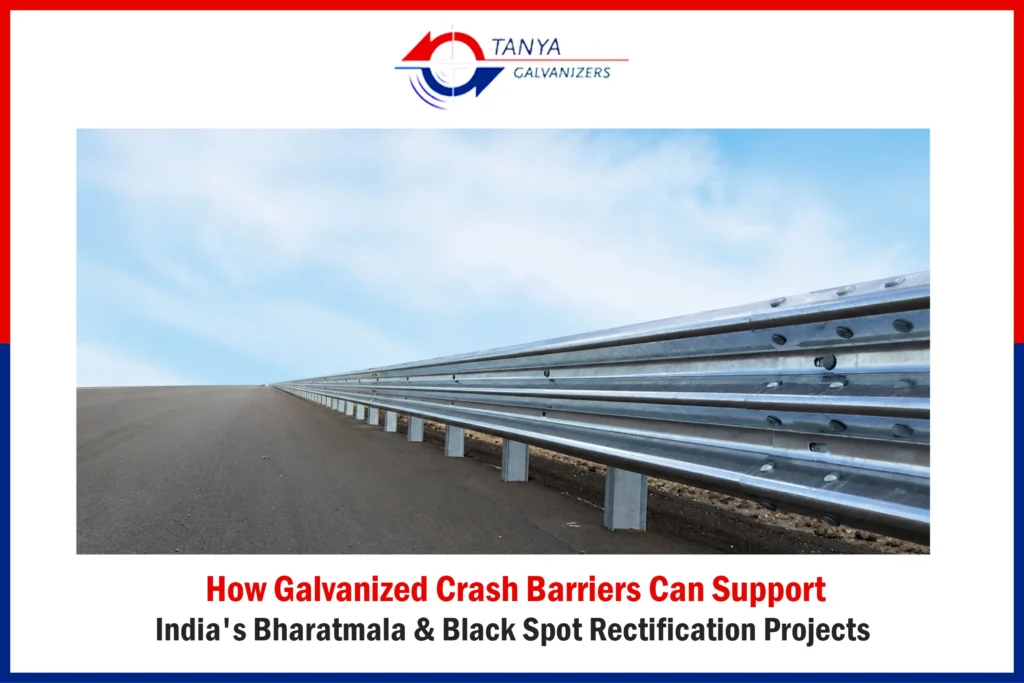
A crash barrier looks like a simple strip of metal running along the road edge, but its job is far from simple. It has to absorb the force of a vehicle at speed, redirect it safely, and survive years of sun, rain, humidity, and road salt without giving way. That last part, the surviving part, is where most barriers actually fail long before their structural life is over. Rust creeps in, the metal weakens quietly, and a barrier that looked fine on paper turns fragile in reality.

Why Bharatmala Needs More Than Roads: The Role of Crash Barrier Manufacturers

The Bharatmala Pariyojana isn’t only about connecting cities and ports faster. It’s also about correcting decades of underinvestment in road safety infrastructure. Thousands of kilometres are being built or upgraded across terrains that range from coastal humidity to dry, dusty interiors and high-altitude cold. A crash barrier manufacturers installed near the coast in Gujarat faces a completely different environment than one installed in the hills of Himachal, yet both need to perform equally well for the next several decades.

This is a big ask for untreated or poorly coated steel. Ordinary painted barriers might look acceptable when freshly installed, but paint chips and scratches happen during transport and installation, and moisture finds its way in. Once corrosion starts under a painted surface, it spreads silently, and by the time visible rust shows up, the barrier has already lost a chunk of its strength. On a project of Bharatmala’s scale, replacing barriers every few years isn’t just expensive; it disrupts traffic, adds to project overheads, and defeats the very purpose of building resilient infrastructure.

Where Black Spot Rectification Comes In

Black spots are the stretches of road where accidents happen again and again, often due to sharp curves, poor visibility, steep gradients, or simply the absence of a barrier strong enough to stop a vehicle from going over an edge. The Ministry of Road Transport and Highways has been working consistently to identify and fix these spots across national highways, and crash barriers are one of the most direct interventions available.

But here’s the catch. A black spot doesn’t get fixed just by installing any barrier. It needs a barrier that will still be doing its job five, ten, fifteen years later, in the exact same condition it was on day one. A weakened, rusted barrier at a black spot is arguably worse than no barrier at all, because it creates a false sense of security for drivers and authorities alike.

The Case for Galvanized Crash Barriers

Hot dip galvanizing is where this problem gets solved properly. In this process, steel barriers are dipped into molten zinc, which bonds with the metal at a metallurgical level rather than sitting on top of it like paint does. The result is a coating that doesn’t peel, doesn’t chip away like paint does, and keeps protecting the steel underneath even if the surface gets scratched during handling or installation. Zinc corrodes far slower than steel, and it also acts as a sacrificial layer, meaning it takes the environmental damage so the steel itself stays intact for much longer.

For highway authorities and contractors working on Bharatmala corridors or black spot correction sites, this translates into fewer maintenance cycles, lower lifetime cost, and barriers that actually perform when a vehicle hits them years down the line. A crash barrier is only as good as its weakest year, and galvanizing pushes that weak point much further out on the timeline.

This is also why choosing the right Crash Barrier Manufacturers services matters as much as choosing the barrier design itself. Not every galvanizing setup delivers a uniform, defect-free zinc coating. Bath composition, dipping time, temperature control, and post-galvanizing inspection all decide whether the final barrier will genuinely last or just look shiny for the first year.

A Long-Term View for a Long-Term Programme with Reliable Crash Barrier Manufacturers

Bharatmala is a decades-long vision, not a one-time construction drive, and Black Spot Rectification is an ongoing commitment rather than a project with a fixed end date. Both need materials that match that long-term thinking. Galvanized crash barriers fit naturally into this approach because they are built to be low-maintenance, corrosion-resistant, and dependable across India’s varied climate zones, whether that’s the coastal belt, the northern plains, or hill terrain.

When public money is being spent on road safety, it deserves to be spent on something that lasts, not something that needs replacing every monsoon season. Galvanized barriers or Crash Barrier Manufacturers offer that assurance, and for authorities and EPC contractors working across highway projects, this is a decision that pays off quietly for years.

Choose Galvanizer for Crash Barriers That Are Built to Last

If your project demands crash barriers that can genuinely stand up to India’s roads and weather, it’s worth working with people who understand galvanizing as a craft, not just a process. Galvanizer brings years of hands-on experience in hot dip galvanizing for crash barriers, cable trays, earthing materials and more, with a plant built to handle project-scale requirements without compromising on coating quality. Reach out to Tanya Galvanizer for your crash barrier galvanizing needs and give your highway project a safety layer that’s actually meant to last the distance.

FAQs

Q1. Why do crash barriers need galvanizing instead of just painting?

 Paint sits on the surface and chips easily during transport or installation, letting moisture reach the steel underneath. Galvanizing bonds zinc directly with the metal, so even scratched areas stay protected, giving the barrier a much longer, more reliable service life.

Q2. How does galvanizing help with black spot rectification projects?

Black spots need barriers that perform consistently for years without weakening. Galvanized barriers resist corrosion far longer than untreated ones, ensuring the safety measure installed today still functions properly a decade later, not just in its first year.

Q3. Is galvanizing suitable for all Indian climate zones?

Yes, zinc coating performs reliably across coastal humidity, dry interior heat, and colder hill regions, which makes it well suited to Bharatmala projects spanning highly varied terrain across the country.

Q4. How long do galvanized crash barriers typically last?

 Properly galvanized crash barriers can last several decades with minimal maintenance, depending on coating thickness and environmental exposure, compared to painted barriers that often need repair or replacement within a few years.

Q5. What should I look for in a crash barrier galvanizing service?

Look for controlled bath composition, correct dipping time and temperature, uniform coating thickness, and proper post-galvanizing inspection. These factors decide whether the barrier will genuinely last or just appear coated on the surface.

Crash Barrier Manufacturers

Top 5 Reasons Why Galvanized Crash Barriers Are India’s Safest Choice for Highways

Every time you drive along a highway, the sturdy metal barriers lining the road silently safeguard lives. These are crash barriers — a crucial part of modern road infrastructure designed to prevent accidents and minimize damage during collisions. Behind their strength lies a powerful technology: galvanisation.As one of the leading crash barrier manufacturers and galvanizers in India, Tanya Galvanizers has been instrumental in building safer highways through high-quality galvanized crash barriers that combine engineering precision with proven corrosion protection.

Let’s explore the top five reasons why Tanya Galvanisers’ crash barriers are India’s safest choice for highways.

1. How Crash Barrier Manufacturers Ensure Superior Protection with Hot Dip Galvanization

The strength of a crash barrier depends not only on the steel but also on its ability to withstand environmental wear and tear. Tanya Galvanizers uses hot dip galvanizing technology to coat steel barriers with molten zinc at 450°C.

This process creates a strong metallurgical bond, offering:

  • Complete protection against rust, moisture, and pollutants.
  • Longer lifespan, even in coastal or high-humidity regions.
  • Reduced maintenance costs over decades of use.

By partnering with one of the most experienced galvanizers in India, highway contractors and government bodies ensure their crash barriers remain strong and corrosion-free for years.

2. Engineered for Maximum Road Safety

Every crash barrier manufactured at Tanya Galvanizers is designed following MORTH (Ministry of Road Transport and Highways) and IRC (Indian Roads Congress) standards.

Our barriers undergo rigorous testing to ensure they can absorb impact efficiently and safely redirect vehicles back onto the roadway.

Key benefits include:

  • Reduced vehicle rollover risks.
  • Enhanced safety during high-speed collisions.
  • Consistent performance across all weather conditions.

With road accidents being a major concern in India, our galvanized crash barriers serve as the first line of defence in protecting both passengers and infrastructure.

3. Crash Barrier Manufacturers Delivering Unmatched Durability and Longevity

Tanya Galvanizers’ crash barriers are built to last. Thanks to high-quality galvanization and precision manufacturing, these barriers maintain their integrity even after years of exposure to harsh conditions.

Why do they last longer?

  • Uniform zinc coating ensures 360° protection.
  • Resistant to chemical corrosion and abrasion.
  • Effective performance in both rural and urban installations.

Our crash barrier manufacturers use advanced galvanizing tanks and automated quality checks to guarantee consistent coating thickness and adhesion — ensuring dependable safety across India’s roads and bridges.

4. Sustainable and Cost-Effective Solution

Sustainability is at the core of Tanya Galvanizers’ production process. Hot dip galvanization is eco-friendly, uses recyclable materials, and reduces the need for frequent replacements.

Advantages for infrastructure planners:

  • Lower lifetime cost compared to painted or untreated steel.
  • Reduced carbon footprint due to less maintenance and waste.
  • Long-term savings for government and private contractors.

This makes our galvanized crash barriers not only safe but also economically and environmentally responsible — a smart choice for modern road safety projects.

5. Expertise, Experience, and Trust

With decades of expertise in galvanising steel for critical applications, Tanya Galvanizers has established itself as one of the top galvanizers in India. Our reputation is built on precision, reliability, and commitment to quality.

We serve national highway projects, bridge constructions, and industrial roadways — providing barriers that meet both international and Indian safety standards.

Our clients trust us because we deliver:

  • Proven performance on large-scale infrastructure projects.
  • Custom galvanizing services based on project requirements.
  • Timely delivery and consistent quality assurance.

India’s growing road network demands safety solutions that last. Galvanized crash barriers from Tanya Galvanizers deliver the perfect balance of durability, strength, and sustainability. As trusted crash barrier manufacturers and galvanizers in India, we combine cutting-edge technology with decades of expertise to make highways safer for everyone.

Contact Tanya Galvanizers today to discuss your project needs and discover how our galvanized solutions can enhance road safety for generations to come.

FAQs

Q1: Why are galvanized crash barriers better than painted ones?
A: Galvanized barriers offer superior corrosion resistance, longer lifespan, and reduced maintenance compared to painted steel, making them more reliable for highways.

Q2: How long do galvanized crash barriers last?
A: With proper galvanization, Tanya Galvanizers’ crash barriers can last up to 50 years depending on environmental conditions.

Q3: Are these barriers suitable for coastal or high-humidity areas?
A: Yes. The zinc coating from hot dip galvanizing prevents rust, making them ideal for coastal, humid, or industrial zones.

Q4: What standards do Tanya Galvanizers’ crash barriers meet?
A: All our barriers adhere to MORTH and IRC standards, ensuring optimal performance and safety.

Crash Barrier Manufacturers

Crash Barrier Manufacturers: Building a Safer Future, One Barrier at a Time

When it comes to road safety, crash barriers play a crucial role. These protective structures are more than just roadside installations; they are lifesaving shields that absorb impact and prevent vehicles from veering off the path. That’s why choosing the right crash barrier manufacturers is critical for highways, bridges, and high-risk zones.

This blog helps you understand how crash barriers work, why galvanizing matters, and what to consider when selecting a manufacturer. We’ll also introduce Tanya Galvanizers, one of India’s most reliable crash barrier galvanizing service providers.

What Are Crash Barriers and Why Are They Important?

Crash barriers, often called guardrails or safety barriers, are installed along roads, highways, and bridges to:

  • Prevent vehicles from entering oncoming traffic
  • Minimize the severity of accidents
  • Absorb impact energy
  • Protect pedestrians, infrastructure, and structures

Without well-manufactured barriers, the risk of fatal road accidents increases drastically. Hence, choosing certified crash barrier manufacturers becomes a matter of public safety.

Types of Crash Barriers

Crash barriers come in various types depending on the use case and location:

  1. W-Beam Crash Barrier
    • Widely used
    • Suitable for highways and flyovers
  2. Thrie-Beam Crash Barrier
    • Offers higher strength and wider coverage
    • Ideal for hilly and sharp-curved terrains
  3. Bridge Crash Barriers
    • Used to safeguard the edges of bridges and overpasses
    • Protects from falls into rivers, railways, or deep valleys
  4. Median Barriers
    • Prevent head-on collisions by stopping vehicles from crossing medians
  5. Flexible and Rigid Barriers
    • Chosen based on environment, impact risk, and design needs

Why Galvanizing is a Must for Crash Barriers?

Crash barriers are exposed to various environmental conditions, including rain, sunlight, pollution, and coastal humidity. Over time, they may rust or weaken if not protected.

This is where galvanizing comes in.

Galvanizing is the process of coating steel with zinc, protecting it from corrosion and extending its lifespan. Tanya Galvanizers offers hot dip galvanizing services that:

  • Provide rust protection for up to 50 years
  • Offer a uniform and durable zinc coating
  • Follow IS 2062, IS 10748, and other standards
  • Require minimal maintenance

Choosing the Right Crash Barrier Manufacturers: What to Look For

When evaluating manufacturers, consider:

  • Experience & Certifications: Choose a company that complies with MORTH specifications and IRC standards.
  • Material Quality: Look for IS-grade steel and precision manufacturing.
  • Galvanizing Capability: Ensure the company offers in-house galvanizing or partners with trusted galvanizers.
  • Past Projects & Client Testimonials: Proven performance is key.
  • Delivery and Support: Timely supply and after-sales support reflect reliability.

Tanya Galvanizers: Trusted Partner in Crash Barrier Galvanizing

Tanya Galvanizers is recognized for its expertise in crash barrier galvanizing. With over two decades of experience, they offer high-quality zinc-coated crash barriers that meet both Indian and international safety standards.

Their state-of-the-art plant in Gujarat serves as a key supplier to leading infrastructure companies across the country. If you are looking for dependable crash barrier manufacturers or galvanizing services, Tanya Galvanizers delivers both quality and trust.

Do you need robust and long-lasting crash barriers for your next project?

Contact Tanya Galvanizers today for high-quality galvanized crash barriers that comply with national safety standards and deliver unmatched performance.

Frequently Asked Questions

  1. What is the purpose of crash barriers?

    Crash barriers prevent vehicles from colliding with hazardous obstacles or falling off the road. They absorb impact and reduce the severity of crashes.

  2. Why is galvanizing necessary for crash barriers?

    Galvanizing protects crash barriers from rust and environmental damage, ensuring a long life and consistent safety performance.

  3. How long do galvanized crash barriers last?

    With proper galvanization, crash barriers can last 25–50 years, depending on exposure conditions and maintenance.

  4. How can I ensure I’m buying from a trusted crash barrier manufacturer?

    Look for certifications, compliance with MORTH & IRC standards, and proven project history.