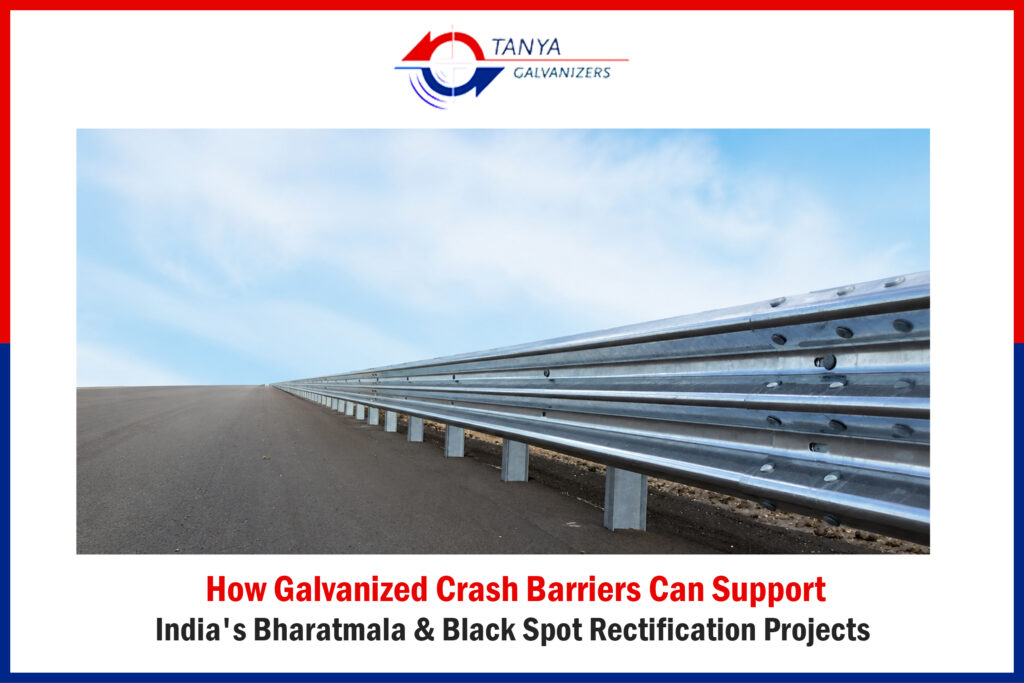
India is building roads faster, and with that speed comes responsibility. Every kilometre added under the Bharatmala Pariyojana and every accident-prone stretch identified under the Black Spot Rectification program comes with one silent expectation: that the safety infrastructure lining these roads will actually hold up. This is exactly where crash barrier manufacturers step into the picture, not as an afterthought but as a core part of how India’s highways are designed to protect lives.
A crash barrier looks like a simple strip of metal running along the road edge, but its job is far from simple. It has to absorb the force of a vehicle at speed, redirect it safely, and survive years of sun, rain, humidity, and road salt without giving way. That last part, the surviving part, is where most barriers actually fail long before their structural life is over. Rust creeps in, the metal weakens quietly, and a barrier that looked fine on paper turns fragile in reality.
Why Bharatmala Needs More Than Just More Roads
The Bharatmala Pariyojana isn’t only about connecting cities and ports faster. It’s also about correcting decades of underinvestment in road safety infrastructure. Thousands of kilometres are being built or upgraded across terrains that range from coastal humidity to dry, dusty interiors and high-altitude cold. A barrier installed near the coast in Gujarat faces a completely different environment than one installed in the hills of Himachal, yet both need to perform equally well for the next several decades.
This is a big ask for untreated or poorly coated steel. Ordinary painted barriers might look acceptable when freshly installed, but paint chips and scratches happen during transport and installation, and moisture finds its way in. Once corrosion starts under a painted surface, it spreads silently, and by the time visible rust shows up, the barrier has already lost a chunk of its strength. On a project of Bharatmala’s scale, replacing barriers every few years isn’t just expensive; it disrupts traffic, adds to project overheads, and defeats the very purpose of building resilient infrastructure.
Where Black Spot Rectification Comes In
Black spots are the stretches of road where accidents happen again and again, often due to sharp curves, poor visibility, steep gradients, or simply the absence of a barrier strong enough to stop a vehicle from going over an edge. The Ministry of Road Transport and Highways has been working consistently to identify and fix these spots across national highways, and crash barriers are one of the most direct interventions available.
But here’s the catch. A black spot doesn’t get fixed just by installing any barrier. It needs a barrier that will still be doing its job five, ten, fifteen years later, in the exact same condition it was on day one. A weakened, rusted barrier at a black spot is arguably worse than no barrier at all, because it creates a false sense of security for drivers and authorities alike.
The Case for Galvanized Crash Barriers
Hot dip galvanizing is where this problem gets solved properly. In this process, steel barriers are dipped into molten zinc, which bonds with the metal at a metallurgical level rather than sitting on top of it like paint does. The result is a coating that doesn’t peel, doesn’t chip away like paint does, and keeps protecting the steel underneath even if the surface gets scratched during handling or installation. Zinc corrodes far slower than steel, and it also acts as a sacrificial layer, meaning it takes the environmental damage so the steel itself stays intact for much longer.
For highway authorities and contractors working on Bharatmala corridors or black spot correction sites, this translates into fewer maintenance cycles, lower lifetime cost, and barriers that actually perform when a vehicle hits them years down the line. A crash barrier is only as good as its weakest year, and galvanizing pushes that weak point much further out on the timeline.
This is also why choosing the right crash barrier galvanizing services matters as much as choosing the barrier design itself. Not every galvanizing setup delivers a uniform, defect-free zinc coating. Bath composition, dipping time, temperature control, and post-galvanizing inspection all decide whether the final barrier will genuinely last or just look shiny for the first year.
A Long-Term View for a Long-Term Programme
Bharatmala is a decades-long vision, not a one-time construction drive, and Black Spot Rectification is an ongoing commitment rather than a project with a fixed end date. Both need materials that match that long-term thinking. Galvanized crash barriers fit naturally into this approach because they are built to be low-maintenance, corrosion-resistant, and dependable across India’s varied climate zones, whether that’s the coastal belt, the northern plains, or hill terrain.
When public money is being spent on road safety, it deserves to be spent on something that lasts, not something that needs replacing every monsoon season. Galvanized barriers offer that assurance, and for authorities and EPC contractors working across highway projects, this is a decision that pays off quietly for years.
Choose Galvanizer for Crash Barriers That Are Built to Last
If your project demands crash barriers that can genuinely stand up to India’s roads and weather, it’s worth working with people who understand galvanizing as a craft, not just a process. Galvanizer brings years of hands-on experience in hot dip galvanizing for crash barriers, cable trays, earthing materials and more, with a plant built to handle project-scale requirements without compromising on coating quality. Reach out to Tanya Galvanizer for your crash barrier galvanizing needs and give your highway project a safety layer that’s actually meant to last the distance.
FAQs
Paint sits on the surface and chips easily during transport or installation, letting moisture reach the steel underneath. Galvanizing bonds zinc directly with the metal, so even scratched areas stay protected, giving the barrier a much longer, more reliable service life.
Black spots need barriers that perform consistently for years without weakening. Galvanized barriers resist corrosion far longer than untreated ones, ensuring the safety measure installed today still functions properly a decade later, not just in its first year.
Yes, zinc coating performs reliably across coastal humidity, dry interior heat, and colder hill regions, which makes it well suited to Bharatmala projects spanning highly varied terrain across the country.
Properly galvanized crash barriers can last several decades with minimal maintenance, depending on coating thickness and environmental exposure, compared to painted barriers that often need repair or replacement within a few years.
Look for controlled bath composition, correct dipping time and temperature, uniform coating thickness, and proper post-galvanizing inspection. These factors decide whether the barrier will genuinely last or just appear coated on the surface.